Guides
What are static bypass and maintenance bypass?
The static bypass is an electronic switch inside the UPS that moves the load to the bypass source in milliseconds when the inverter cannot carry it; the maintenance bypass is a mechanical path around the whole UPS so it can be serviced while the load stays powered. In both, the load runs on unconditioned power.
On this page
Key facts
- Static bypass trigger:
- Severe inverter overload, or a rectifier or inverter failure Eaton
- Forced static bypass:
- Load on the bypass source; batteries not available as an alternate source (Galaxy VS)
- Internal maintenance bypass:
- Unconditioned power from the bypass source; power modules, static switch and controller serviceable (Galaxy VS)
- External maintenance bypass:
- Unconditioned power; the entire UPS serviceable (Galaxy VS)
- ECO mode:
- Load on requested static bypass; a transfer may interrupt the supply for up to 10 ms (Galaxy VS)
Static Bypass or Maintenance Bypass: What Does Each Do?
Static bypass
Short answer
The static bypass catches the load when the inverter cannot carry it. Eaton's UPS basics paper explains that on a severe overload of the inverter, or a failure of the rectifier or inverter, the static switch bypass path is turned on quickly so that unconditioned AC from the source supports the load. Some UPS add a mechanical contactor alongside the static switch; Mitsubishi describes its 9900B as having a static switch with a wrap-around contactor.
Requested and forced static bypass
Requested and forced static bypass are the two ways the load reaches the static bypass. In Schneider Electric's Galaxy VS manual, requested static bypass follows a command from the display: the load runs on the bypass source, and the UPS returns to double conversion or forced bypass if a fault is detected, or goes to battery if the utility is interrupted. Forced static bypass follows a command from the UPS itself or the inverter being switched off; the load runs on the bypass source and the batteries are not available as an alternate source.
Maintenance bypass
The maintenance bypass takes the UPS out of the load path entirely. The Galaxy VS manual describes two forms: an internal maintenance bypass, which allows service on the power modules, the static bypass switch module and the controller, and an external maintenance bypass in a separate panel or switchgear, which allows service on the entire UPS. In both the load is supplied with unconditioned power from the bypass source, and for the external bypass the manual notes that the batteries are not available.
| Path | How the load moves | What can be serviced | Battery available? |
|---|---|---|---|
| Static bypass (requested) | Electronic, by command | Nothing inside the power path | On a utility interruption |
| Static bypass (forced) | Electronic, by the UPS | Nothing inside the power path | No |
| Internal maintenance bypass | Mechanical, inside the UPS | Power modules, static switch, controller | Check the model |
| External maintenance bypass | Mechanical, outside the UPS | The entire UPS | No |
The load on bypass
On any bypass the load runs on the bypass source without conditioning, and on some paths without the battery behind it. Bypass time is therefore planned: the window, the expected duration, the generator status and the weather all go into the written method. In Eaton's load bank method, for example, the critical load is moved to bypass and then maintenance bypass before the UPS is shut down, and returned the same way once testing is complete; see load bank test procedure.
ECO mode and the static bypass
ECO mode runs the load on the static bypass while the utility is within tolerance, to save energy. The Galaxy VS manual notes that, depending on the transfer conditions, a minimal interruption of the load supply of up to 10 ms may happen when the UPS transfers back. Whether that is acceptable depends on the load; Schneider Electric's eConversion keeps the inverter running in parallel to avoid it; see types of UPS.
Bypass on a dual-path site
On a Tier III or IV site, where Uptime Institute describes dual power paths to the IT equipment, a UPS on bypass affects one path while the other carries the load through its own UPS. On a single-path site, every bypass is a period of reduced protection for the whole load. For repairs that put a UPS on bypass, see emergency UPS repair; for what to check on site when a unit sits on bypass, see UPS bypass mode, normal versus critical.
Related pages
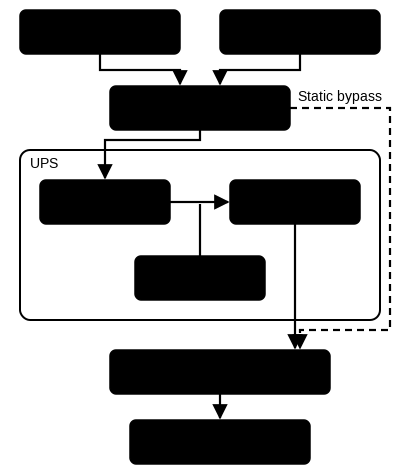
How does a data-centre UPS work?
Rectifier, battery, inverter, bypass and the modes.
Emergency UPS repair
What to do when a UPS fails, and how repairs run.
Recorded: Model, alarm text, load state, time
Load bank test procedure and requirements
Site requirements and the step-by-step method.
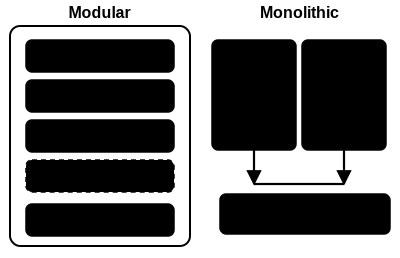
Modular vs monolithic UPS
How each is built, scaled and serviced.
Selected regional variants. Exact configuration and availability confirmed for each request.
Questions
Is the static bypass the same as the maintenance bypass?
No. The static bypass is an electronic switch inside the UPS that acts in milliseconds; the maintenance bypass is a mechanical path around the UPS used for service.
Are the batteries available in maintenance bypass?
Often not: the Galaxy VS manual notes the batteries are not available in external maintenance bypass, nor in forced static bypass. Check your model's manual.
Can a UPS be serviced without a maintenance bypass?
Only with the load shut down, or with another UPS or path carrying it. A maintenance bypass is what allows service with the load powered.
Does ECO mode use the bypass?
Yes. In ECO mode the load runs on the static bypass while the utility is in tolerance, returning to double conversion on a fault.
Sources, checked 2026-10-04:
- Manual Schneider Electric, Galaxy VS UPS operation manual 990-5910G, operation modes, p. 15-16
- White paper Eaton, UPS basics (white paper WP153005EN), p. 2-5
- Reference Eaton, Load Bank Testing Scope of Work, Attachment L-6 (revised 5/12/2015), p. 1
- Reference Mitsubishi Electric, 9900B UPS product page
- Reference Uptime Institute, Dual-corded power and fault tolerance: past, present and future
Need a UPS serviced, tested or replaced?
Tell us the site, the UPS and the timing. We reply and quote within 4 business hours, or call 1 (438) 800-0382